A dining table is easy to judge in an empty shop and harder to judge in a room where someone must pass behind a seated diner. Perhaps your table hosts two people on weekdays, four on Sundays and a laptop between meals. The most useful choice depends on those ordinary movements as much as on the number of place settings in a product photograph. Start by listing the people who usually sit down together and the route other household members take through the room. Then compare shapes, bases and finishes against that routine. This guide offers a practical way to make that comparison before committing to a substantial purchase.
In this guide
Map the room with chairs in useUnderstand what a round table changesConsider the quiet strengths of a rectangleTreat an extending mechanism as equipmentChoose a finish for your habitsBudget for the complete arrangementLeave room for the household to changeCompare your optionsBefore you buyCommon questionsMap the room with chairs in use
Measure the table zone and draw surrounding doors, radiators and cabinetry. Mark a proposed tabletop with masking tape or paper, then place your existing chairs around it. Pull a chair out as you would to stand up and walk behind it carrying a plate. A table that fits while every chair is tucked in may make the room awkward for most of the evening. There is no single clearance figure that suits every household or chair. Use the movement test to decide what feels comfortable for the people who actually use the space, including any mobility equipment.
Understand what a round table changes
A round top removes corners from the visual outline and can make conversation feel more connected. A central pedestal may offer flexibility in chair placement, but the base itself can limit where feet rest. Four substantial upholstered chairs can occupy more space than the table photograph suggests. Check the diameter against complete place settings and serving dishes, especially if you prefer food in the centre. A very small round table may suit breakfast beautifully yet leave little room for homework and a meal simultaneously. Shape helps circulation, but it cannot create surface area that the room does not contain.
Consider the quiet strengths of a rectangle
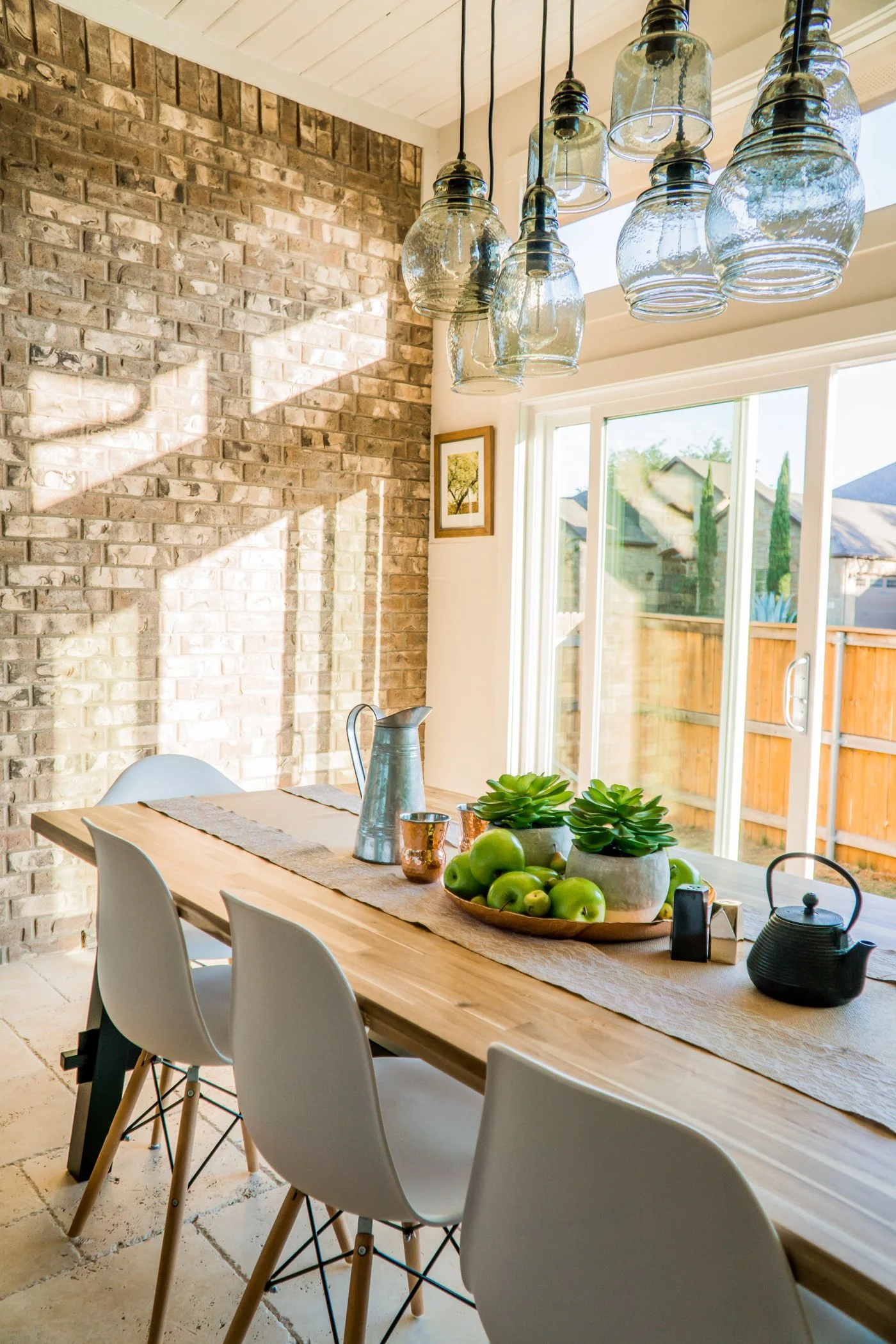
A rectangular table suits a long room and can sit close to a wall when one side is temporarily unused. It usually gives a clear division between place settings and a central serving strip. The tradeoff is that corners and end chairs can interrupt circulation. Look at the relationship between legs and chairs: a generous top does not guarantee comfortable knee space. If you often work at one end, consider whether the table depth supports a laptop and papers without forcing dining items to remain permanently stacked elsewhere. Simple geometry can be more adaptable than an unusually sculptural base.
Treat an extending mechanism as equipment
An extending table is worthwhile when you can actually deploy it without rearranging half the house. Ask where spare leaves live, how heavy they are and whether one person can operate the mechanism. Inspect or request photographs of the join, support legs and underside. Check the dimensions both closed and fully extended and repeat your circulation test in both arrangements. An occasional crowded celebration may be an acceptable compromise, but a leaf that blocks the kitchen entrance is a different issue. Confirm the care instructions and avoid assuming that every table tolerates damp storage or frequent assembly in the same way.
Choose a finish for your habits
Visible wood grain, painted surfaces and laminate create different visual characters, but maintenance matters more than a finish name. Read the maker's instructions on heat, spills, cleaning products and any re-oiling requirements. Families using craft materials may prefer a surface with straightforward cleaning guidance and a protective table covering for messy work. A textured finish can disguise small marks while making crumbs harder to remove from grooves. Ask for a sample where available and look at it in your own light. Do not infer scratch resistance or stain performance from a promotional photograph.
Budget for the complete arrangement
Add chairs, delivery, assembly and protective accessories to your comparison. A table that requires unusually narrow chairs can increase the total cost if your current set will not fit. Consider whether one bench would be practical, remembering that everyone on it may need to move when the person at the far end leaves. Buy for regular use and make a separate plan for occasional guests. Borrowing a folding table for a large gathering may be more sensible than living around an oversized permanent table all year. Keep some budget for the items you have identified as essential rather than spending it entirely on the tabletop.
Leave room for the household to change
Think about a visiting relative, a different chair or a meal using larger serving dishes. You do not need to plan for every possible event, but avoid a layout that works only when everyone follows an exact seating order. Keep a note of dimensions and materials, including care instructions. This makes it easier to source compatible seating or a covering later without repeating the entire decision. Reassess after living with the table before adding more furniture. A useful test is to set your ordinary weekday meal and your usual guest meal on the proposed footprint, with glasses and serving pieces included.
Compare your options
| Option | Best for | The trade-off |
|---|---|---|
| Round table | Conversation and a compact central arrangement | Diameter limits serving space |
| Rectangular table | Long rooms and mixed work-and-dining use | Corners and end chairs need room |
| Extending table | Small meals with occasional guests | Mechanism and leaves need space |
Before you buy
- Measure chairs pulled out, not just tucked in.
- Inspect leg positions and knee space.
- Record both dimensions of an extending design.
- Compare the total cost of table, seating and delivery.
Common questions
Can a round table seat more people?
It depends on diameter, base and chair width. Compare actual place settings and leg space rather than trusting a headline seat count.
Is a bench always better in a small room?
A bench may tuck away neatly, but access can be awkward when several people share it. Test sitting down and leaving before choosing it.
Useful sources & shopping starting points
Use the retailer's current measurements, care information and delivery terms to check any shortlisted item. Availability and prices can change.